
Last reviewed by James Vandegrift, Co-Founder — May 2026
← Back to BlogTILE MATERIALS
Tile Material Comparison: Porcelain, Ceramic, Natural Stone, and Large-Format Slabs
KV Tileworks LLC · Sanford, FL · 2026
The material you choose affects maintenance, durability, installation method, and long-term performance. Porcelain handles anything. Ceramic works on walls. Natural stone needs sealing. Large-format slabs need a flatter substrate and more careful handling than any of them. This reference covers what actually matters when you are choosing tile for a real project.
Quick Reference: At-a-Glance Comparison
| Material | Water Absorption | Hardness (PEI) | Sealing Required | Best For | Material Cost (per sq ft) |
|---|---|---|---|---|---|
| Porcelain | <0.5% (vitreous) | PEI III–V | No | Floors, showers, exterior, heavy traffic | $3–$15+ |
| Ceramic | 3–7% | PEI I–III | Sometimes (grout only) | Wall tile, backsplashes, low-traffic floors | $2–$8 |
| Marble | 0.2–0.5% | Soft–Medium | Yes — annual | Showers, accent walls, feature floors | $10–$30+ |
| Travertine | 1–3% | Soft–Medium | Yes — annual | Floors, showers, outdoor areas | $5–$18 |
| Limestone | 1–5% | Soft | Yes — annual | Flooring, low-moisture walls | $6–$20 |
| Large-Format Porcelain Slab | <0.5% | PEI IV–V | No | Shower walls, feature walls, large floors | $8–$25+ |
Porcelain Tile
Porcelain is made from refined kaolin clay fired at temperatures above 2,200°F. The result is an extremely dense tile with water absorption below 0.5% — classified as vitreous or impervious. It is the most versatile tile material available.
In Central Florida's climate, porcelain handles the humidity, UV exposure, and temperature swings without issue. It works in showers, on floors, on exterior surfaces, and in commercial settings. You do not seal it. You do not worry about it. In terms of pure durability and low maintenance, nothing beats porcelain.
Porcelain: Pros and Cons
Advantages
- Water absorption below 0.5% — no sealing required
- Extremely hard and scratch-resistant (PEI III–V)
- Works on floors, walls, showers, and exterior
- Frost-resistant — relevant for covered outdoor areas in FL
- Wide range of looks including realistic stone and wood visuals
- Low long-term maintenance
Considerations
- Harder to cut than ceramic — requires diamond blade wet saw
- Heavier than ceramic, especially large formats
- More expensive than ceramic for comparable sizes
- Requires proper thinset coverage (95% on floors/showers) — no shortcuts
Ceramic Tile
Ceramic tile is the traditional choice — made from less refined clay fired at lower temperatures. It is softer, easier to cut, and lighter than porcelain. It absorbs more water, which is why it has specific use limitations.
The practical rule: ceramic works on walls. For shower walls, backsplashes, and light-traffic bathroom floors, ceramic is a solid option at a lower cost. On shower floors or high-traffic areas, porcelain is the better call.
Ceramic: Pros and Cons
Advantages
- Less expensive than porcelain
- Easier to cut — scores and snaps cleanly
- Lighter weight — easier handling on walls
- Wide color and style selection at every price point
- Groutable without risk of water penetration on walls
Considerations
- Higher water absorption (3–7%) — not for shower floors
- Softer surface — can chip or crack under heavy impact
- Not suitable for exterior use in freeze-thaw climates
- PEI I–II ratings should not be used on floors at all
Natural Stone Tile
Natural stone means marble, travertine, limestone, slate, quartzite, and similar materials cut from rock. Each piece is unique. The variation is part of what makes it look expensive — because it is.
The tradeoff is maintenance. Natural stone is porous. Water gets in. Without sealing, moisture causes staining, etching (on marble from acidic cleaners or hard water), and in a shower, potential issues behind the tile. Proper sealing on installation and annually after that is not optional — it is the cost of owning natural stone.
In high-end homes in Central Florida — Heathrow, Lake Forest, Winter Park, Windermere — natural stone, particularly marble, is a common request. The aesthetic is unmistakable and it photographs well. The right substrate, proper sealing, and correct thinset selection make it perform for decades.
Natural Stone: Pros and Cons
Advantages
- Unique, high-end aesthetic that porcelain mimics but does not fully replicate
- Adds real perceived value in luxury homes
- Can be honed, polished, or brushed for different looks
- Natural variation means no two installations look exactly the same
- Marble and travertine hold well in showers when properly installed and sealed
Considerations
- Must be sealed at installation and annually after
- Marble etches on contact with acidic cleaners — no vinegar, no citrus
- Harder to repair if a piece chips — matching is difficult
- Requires white thinset to avoid staining through the stone
- Heavier than ceramic; substrate must be solid
- Material cost is higher than porcelain in comparable looks
Large-Format and Slab-Style Porcelain
Large-format tile is any tile 15 inches or larger in any dimension. Slab-style porcelain panels can run 48x96 or larger — essentially continuous sheets that replicate the look of marble with no seams across an entire wall.
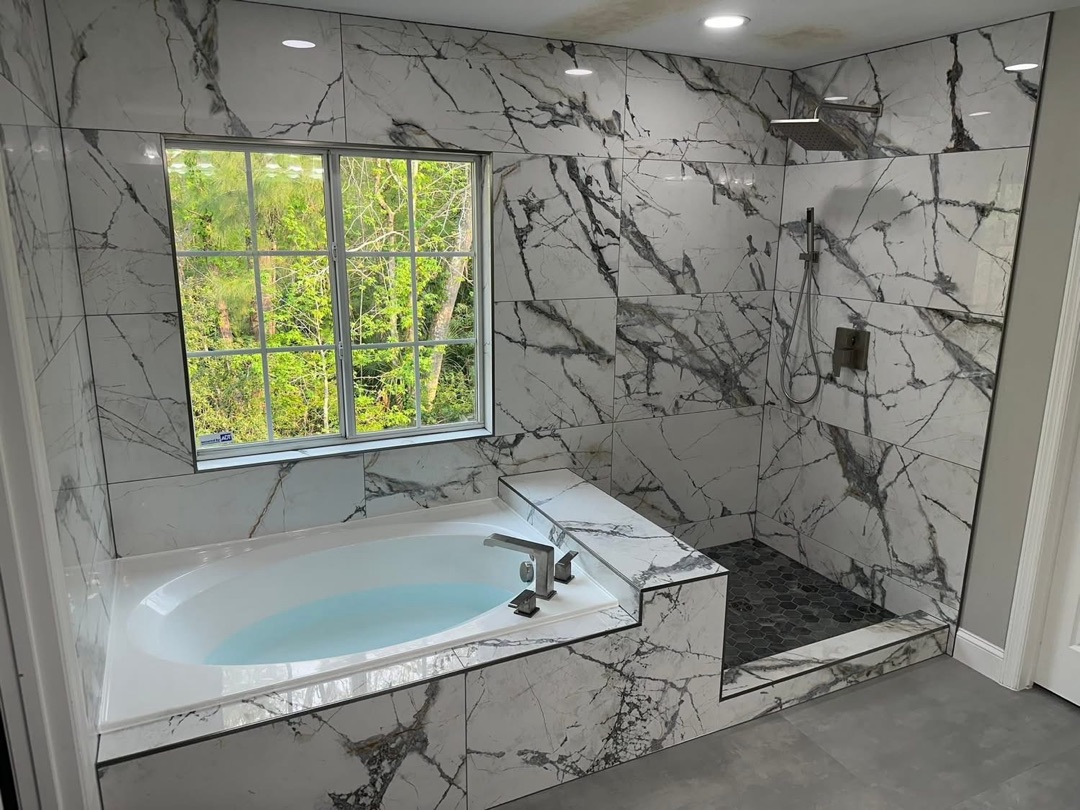
The trend toward large format is real and justified. Fewer grout lines means a cleaner look. On shower walls, a 48x96 slab with two panels covering the full wall and one horizontal seam looks completely different from a 12x24 grid. That is what is selling in Heathrow and Winter Park right now — large-format porcelain with minimal grout lines on shower walls.
The installation requirements are more demanding than standard tile. The substrate has to be flatter — large format shows any variation in the plane that a smaller tile would bridge. Thinset coverage must be full: 95% on floors, 80% minimum on walls, with back-buttering on every piece. A leveling system is mandatory to control lippage. Handling requires two people on anything over 24x48.
Large-Format Porcelain: Pros and Cons
Advantages
- Fewer grout lines — cleaner, more modern look
- No sealing required (same as standard porcelain)
- Continuous look on shower walls with minimal seams
- Available in realistic marble and stone patterns that read as natural stone at a distance
- High PEI ratings — durable under heavy traffic
Considerations
- Substrate must be very flat — large format exposes any variation
- Requires back-buttering every piece (adds labor time)
- Leveling system mandatory to control lippage
- Cuts require a large-capacity wet saw — no snap cutters
- Two-person handling on formats above 24x48
- More expensive per square foot than standard porcelain
Choosing the Right Material for Your Project
The short version:
- Shower floor: Porcelain (mosaic or small format for slope), or natural stone with proper sealing. Not ceramic.
- Shower walls: Porcelain, natural stone, or large-format slab. Ceramic works if you are watching budget, but invest in porcelain on the floor.
- Bathroom floor: Porcelain rated PEI III or higher. Large format if the substrate will support it.
- Kitchen backsplash: Ceramic, porcelain, or natural stone — all work. Ceramic is often the right call here; it is easier to cut around outlets and windows.
- Outdoor areas: Porcelain only. Natural stone is acceptable on covered patios with proper drainage. Ceramic is not rated for exterior use.
- Feature walls and fireplace surrounds: Natural stone or large-format porcelain slab. This is where the material choice matters most to the finished look.
What We Use at KV Tileworks
In Central Florida's high-end residential market, most of our work involves porcelain — large-format porcelain on shower walls, rectified porcelain on floors, and occasionally natural stone (primarily Calacatta marble) for master baths in homes where the budget supports the maintenance commitment.
The material choice always starts with the client's goals and their tolerance for maintenance. If someone wants zero maintenance and a modern look, large-format porcelain is the answer. If they want the warmth and uniqueness of natural stone and understand what goes into keeping it, we make that work the right way.
What we do not do is install the wrong material for the location to save time or money on the front end. Ceramic on a shower floor, or unsealed marble in a steam shower, creates problems later that are expensive to fix. The right material in the right place is the foundation of work that holds up.
Need help choosing tile for a project in Central Florida?
We work with a network of tile suppliers and can help you select material that fits your space, style, and budget. Written estimates, no surprises.
Request an Estimate