
Last reviewed by James Vandegrift, Co-Founder — May 2026
← Back to BlogWATERPROOFING
Shower Waterproofing Systems Compared
KV Tileworks LLC · Sanford, FL · 2026
The four main shower waterproofing systems are Go Board (built-in waterproof foam panel), Schluter KERDI (sheet membrane), liquid-applied membranes like RedGard, and Wedi board, each has a different install method, price point, and best use case, and picking the wrong one for your situation creates problems down the road.
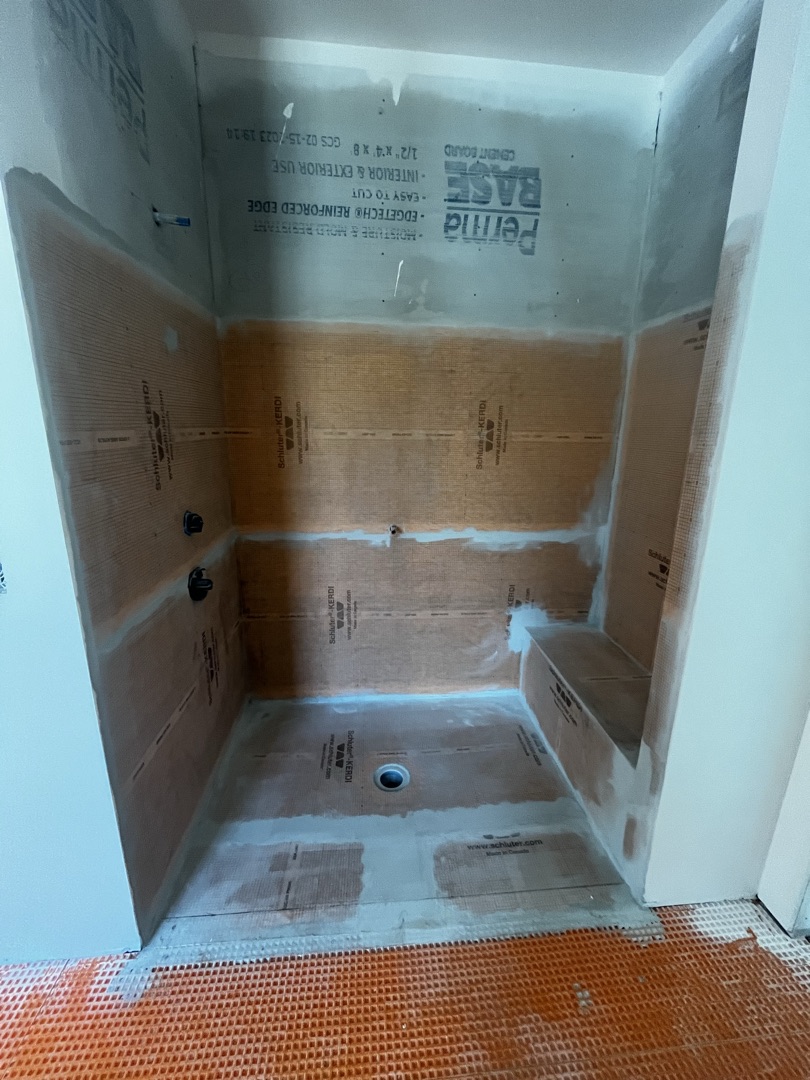
Kerdi, RedGard, Go Board, Wedi, HardieBacker, foam board, liquid membranes. There are more options than ever for waterproofing a tile shower, and most of them are genuinely good. The question is which one fits your project. This is a breakdown from a contractor who works with all of them.
Why Waterproofing Matters So Much
Tile itself is not waterproof. Grout is not waterproof. Water gets through both and if there is nothing stopping it behind the tile, it will reach the framing, the subfloor, and eventually cause rot or mold. In Florida's humidity that process can move fast.
The waterproofing layer is what actually protects your home. It lives behind the tile where you will never see it, which is exactly why it has to be done right. The systems below all accomplish the same goal by different means. None of them are bad. Each has a context where it is the right call.
Quick Reference: Systems at a Glance
| System | Type | Works With | Best For | Watch Out For |
|---|---|---|---|---|
| Schluter Kerdi | Sheet membrane | Unmodified thinset only | Full shower builds, Schluter system integration | Modified thinset voids bonding and warranty |
| Kerdi-Board | Foam panel + waterproof layer | Unmodified thinset for tile; system accessories | Custom niches, benches, one-brand builds | More expensive than cement board + membrane |
| Go Board (Johns Manville) | Foam panel with fiberglass face | Modified or unmodified thinset | Fast installs, ceiling use, standard tile sizes | Not ideal as floor substrate for large-format tile |
| Wedi Board (Wedi) | Foam panel with cement-coated face | Modified thinset; Wedi sealant at seams | High-end builds, Wedi system integration | Premium cost; not ideal for large-format floor tile |
| RedGard | Liquid-applied membrane | Cement board, concrete, masonry | Straightforward shower geometry, brush-on application | Corners and seams need fabric reinforcement |
| HardieBacker + membrane | Substrate only (not waterproof alone) | Any membrane over top | Budget builds paired with a proper membrane | Water passes through uncoated HardieBacker freely |
The Systems in Detail
Schluter Kerdi
Kerdi is a thin polyethylene sheet membrane with fleece laminated to both sides. It bonds directly to cement board or Kerdi-Board with unmodified thinset. The fleece gives the thinset something to grip on both sides, creating a fully bonded waterproof layer across every surface.
It has been around long enough to have a strong track record and Schluter's system is well thought out. The Kerdi-Band corner strips, Kerdi-Drain flange integration, and Kerdi-Board substrate all work together as a complete system, which takes some of the guesswork out of transitions and details.
- Excellent at corners and seams when installed correctly
- Integrates with Schluter's drain and niche products
- Requires unmodified thinset only. Modified thinset prevents proper bonding and voids the warranty
- Sheet application takes time to do well, especially on outside corners
Schluter Kerdi-Board
Kerdi-Board is an extruded polystyrene foam panel with Kerdi fleece laminated to both faces. It serves as both the substrate and the waterproofing layer in one product. You set it on the studs, tape and thinset the seams, and you are essentially done with waterproofing before you ever apply a separate membrane.
It is lightweight, easy to cut, and very fast to install compared to cement board. The foam core also gives you something to anchor into for niches and shelving without adding blocking. For new construction or full gut remodels, it is a strong option that saves real time.
- Substrate and waterproofing combined into one product
- Lighter and faster to install than cement board
- Good for custom niches and shelves. Anchors directly into the foam
- More expensive than cement board plus a separate membrane
Go Board (Johns Manville)
Go Board is made by Johns Manville, not to be confused with Wedi Board, which is a separate product from a different manufacturer. Go Board is made from extruded polystyrene with a fiberglass mat on both faces and is fully waterproof right out of the box. Seams and corners are taped and thinsetted just like Kerdi-Board.
Go Board works with both modified and unmodified thinset as a substrate, which gives more flexibility on the job. It is slightly more rigid than some other foam boards, which some installers prefer for wall tile.
Note on floor use: Go Board works well for standard mosaic or small-format tile on shower floors. For large-format tile (12x24 or larger) on a shower floor, a mud bed is a better substrate. Large-format tile needs a very firm, consistent base that foam cannot fully provide.
- Compatible with modified or unmodified thinset (as a substrate)
- Fully waterproof panel, no separate membrane needed
- Good alternative to Kerdi-Board at a similar price point
- Not the best choice under large-format floor tile
Wedi Board (Wedi)
Wedi Board is made by Wedi, a German company. It is extruded polystyrene with a polymer-modified cement coating on both faces, which gives it more surface hardness than plain foam boards. Wedi has its own line of sealants, screws, and joint tape that are designed to work as a system.
The cement coating makes Wedi feel more substantial underfoot and on walls, and it bonds well with most thinsets including modified. It is one of the more premium options and is popular in high-end shower builds. Like Go Board, Wedi foam panels work best with standard or small-format tile on shower floors. For large-format tile (12x24 or larger) on a shower floor, a mud bed is the stronger choice.
- Cement-coated faces are more rigid and impact resistant than plain foam
- Works with modified thinset
- Wedi's proprietary sealant at seams creates a robust waterproof joint
- Among the more expensive panel options on the market
RedGard
RedGard by Custom Building Products is a liquid-applied waterproofing membrane. You roll or brush it onto cement board, skim-coated drywall, or concrete in two coats. It starts out pink and turns a solid red when it is dry and at the correct thickness. That color change is a useful feature: it tells you where you have gaps in coverage.
RedGard is fast, straightforward, and does not require seaming or embedding anything. It is a good choice for installers who are more comfortable with a brush than with laying sheet membrane, and it works well in showers that do not have complicated geometry.
Critical note on corners and seams: Apply a second coat over all corners, and embed fabric mesh tape into the wet first coat at every corner and seam before the second coat goes on. A liquid membrane that is not reinforced at corners is the most common point of failure. The membrane at a flat wall surface is fine. The corner is where thermal movement, substrate flex, and water pressure all converge. Fabric reinforcement at every corner is not optional.
- Easy to apply. No seams, no fabric to embed in flat areas
- Color-change indicator shows dry coverage
- Works on cement board, concrete, and masonry
- Corners and seams must be reinforced with fabric mesh tape before the second coat
- Two coats needed, with cure time between
HardieBacker + Membrane
HardieBacker is cement board, not a waterproof product on its own. It is important to be clear about that. It is an excellent tile substrate: dimensionally stable, resistant to mold and rot, and it does not deteriorate from water contact the way drywall does. But water passes right through it.
In a shower, HardieBacker needs a waterproofing membrane applied over it, whether that is RedGard, Kerdi sheet, or another liquid or sheet system. Used correctly as part of a complete system, it is a proven and reliable substrate. Used alone, it is not sufficient.
- Excellent tile substrate: flat, stable, and durable
- Not waterproof on its own. Requires a membrane over it
- Lower cost than foam board systems
- Heavier and harder to cut than foam-based backers
- Widely available and familiar to most installers
Quick note on cement board in general: Products like HardieBacker, Durock, and Wonderboard are all cement board options. They share the same basic characteristic: good substrate, not inherently waterproof. Any of them paired with a proper membrane is a solid shower build.
How a Contractor Actually Chooses
On a high-end custom shower with a lot of niches, a custom mud bed floor, and large-format tile, a foam board system like Kerdi-Board or Wedi tends to make the most sense. The built-in waterproofing simplifies the process and the foam is easy to work with for custom cutouts.
On a straightforward tub surround or a smaller shower with standard geometry, cement board plus RedGard or Kerdi sheet is a solid approach and keeps material costs in check.
For the floor, the waterproofing always integrates with the pan system. On a custom mud bed, a sheet membrane like Kerdi bonds over the cured mud and up the walls. On a foam shower pan, the manufacturer's compatible membrane system is usually the right call. And for any large-format tile on the shower floor, a mud bed is the right base regardless of which waterproofing system you choose for the walls.
The one thing that never changes: the membrane has to be continuous, all transitions and corners have to be properly sealed, and it should be flood tested before tile goes in. No shortcuts on that part regardless of which system you use.
The Bottom Line
Every system on this list works when installed correctly. The differences come down to complexity of the shower, installer experience with the product, budget, and timeline. There is no single right answer, which is why it is worth asking your contractor what they use and why. If they can explain the reasoning clearly, that is a good sign they actually know what they are doing. For a full overview of what goes into a bathroom remodel, see our services page.
Frequently Asked Questions
Working on a Shower in Central Florida?
KV Tileworks handles full shower builds, custom waterproofing, and tile installation across Seminole, Orange, Volusia, Lake, and Osceola counties.
Request an Estimate